
Clipping explained for brands
Clipping turns one hour of existing content into dozens of short videos distributed by a community of creators. An acquisition lever paid on performance, not on promises.
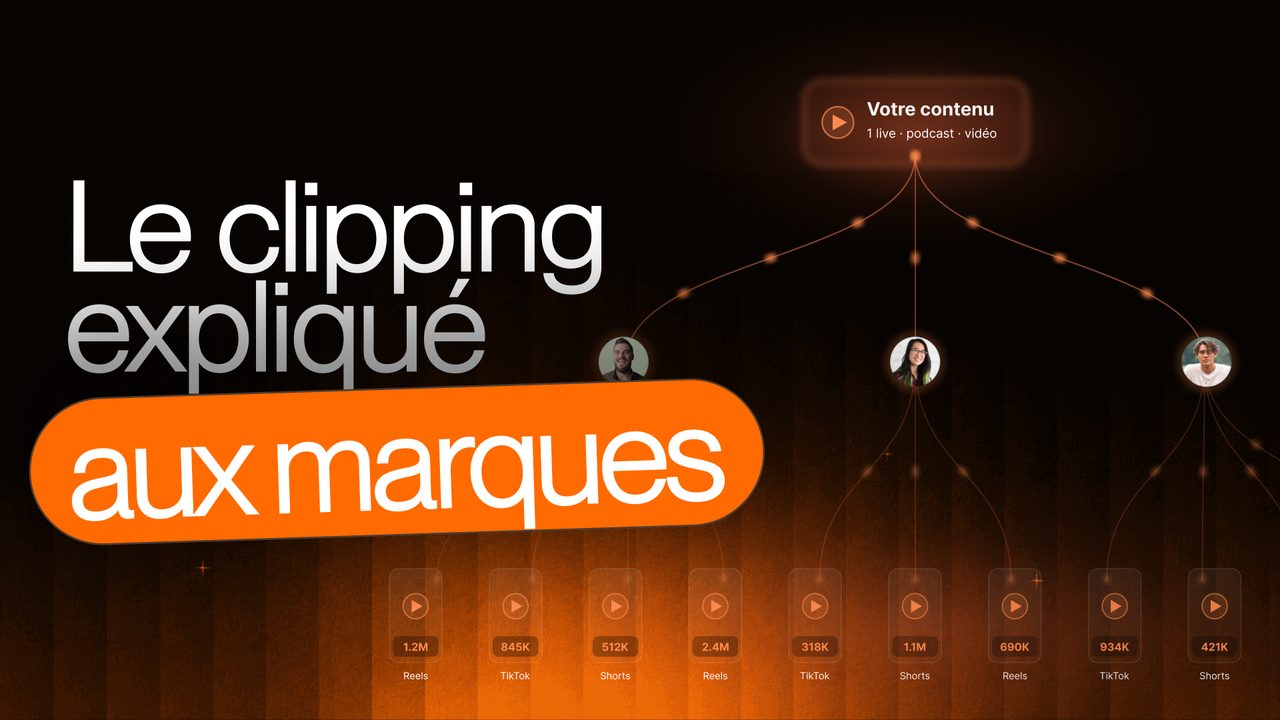
What is clipping?
Clipping doesn't create content, it multiplies its distribution surface.
The principle is simple. You already have material: a podcast, a webinar, a talk, live streams, interviews. That long-form content sleeps on a YouTube channel nobody watches in full. Clipping means handing that material to a community of clippers, independent editors who cut, subtitle and repackage those sequences into vertical videos of 15 to 60 seconds. Each one posts on their own TikTok, Instagram Reels and YouTube Shorts accounts. Where an in-house team produces five videos a week, a network of several hundred clippers produces several thousand a month. It's not a difference of degree, it's a change of scale.
Performance
You don't pay for a campaign, you pay for views actually generated.
This is what separates clipping from classic advertising. On Meta or TikTok Ads, you buy ad inventory at a CPM set by the auction, and your videos are identified as ads by both the algorithm and the audience. In clipping, pay is indexed on real performance: clippers are paid per thousand views generated, and the brand pays a CPM that decreases as volume grows. No views, no cost. The content circulates organically, in the feed, with no sponsored label, with completion and share rates far beyond any ad format. Acquisition cost collapses because the media is no longer bought, it is earned.
Scaling up
A clipping campaign is run like an ad network, not like a shoot.
Launching a campaign takes three things. First, a sufficient source library: count at least ten hours of usable content to feed a first cycle. Next, a clear creative framework, meaning explicit brand rules on what can be cut, the hooks allowed, how subtitles are handled, the sequences that are off limits. Without that framework, scale produces noise rather than signal. Finally, a measurement and ranking system: the best clippers must be identified and paid more, otherwise average quality drifts down to the minimum required. That is exactly the role of a clipping agency. You provide the material and the guardrails, the agency handles recruitment, community management, quality control and pay-per-view billing.
Read our articles regularly? Add Virality® to your preferred sources on Google to find them more easily in your search results.